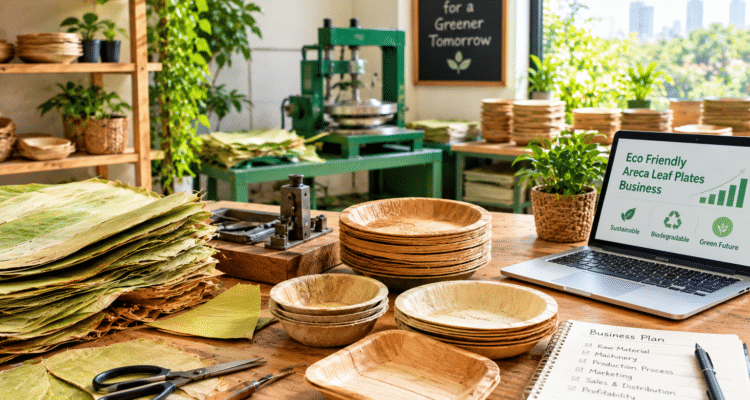
Plastic plates are on their way out. Areca leaf plate making business is growing popularity. Weddings, caterers, cloud kitchens and food stalls all want eco-friendly options. One of the simplest to make is the areca leaf plate.
You do not need a big factory or special degrees. A small unit with one machine can start for a few lakh rupees. But this business also has real risks, especially in exports. In this guide, I explain everything in simple words, with honest numbers.
Note: All money figures here are rough estimates. Your results will depend on your location, raw material price, buyers and effort. Always get quotes before you invest.
1. What Is Areca Leaf?
Areca leaf plates are not made by cutting down trees. They are disposable tableware made from the naturally shed leaf sheaths of the areca palm. The sheath is the wide, fibrous part that joins the leaf to the tree. When it dries, it falls to the ground. Farmers usually have no use for it, so it is collected as agro-waste.
This is why these plates are popular:
- They are natural and biodegradable.
- No tree is cut for them.
- They can hold hot, cold and wet food.
- They look rustic and premium, with natural vein patterns.
A typical plate weighs about 15 to 25 grams and is about 1.5 to 2 mm thick.
2. How Are Plates, Bowls and Cutlery Made from Areca Leaf?
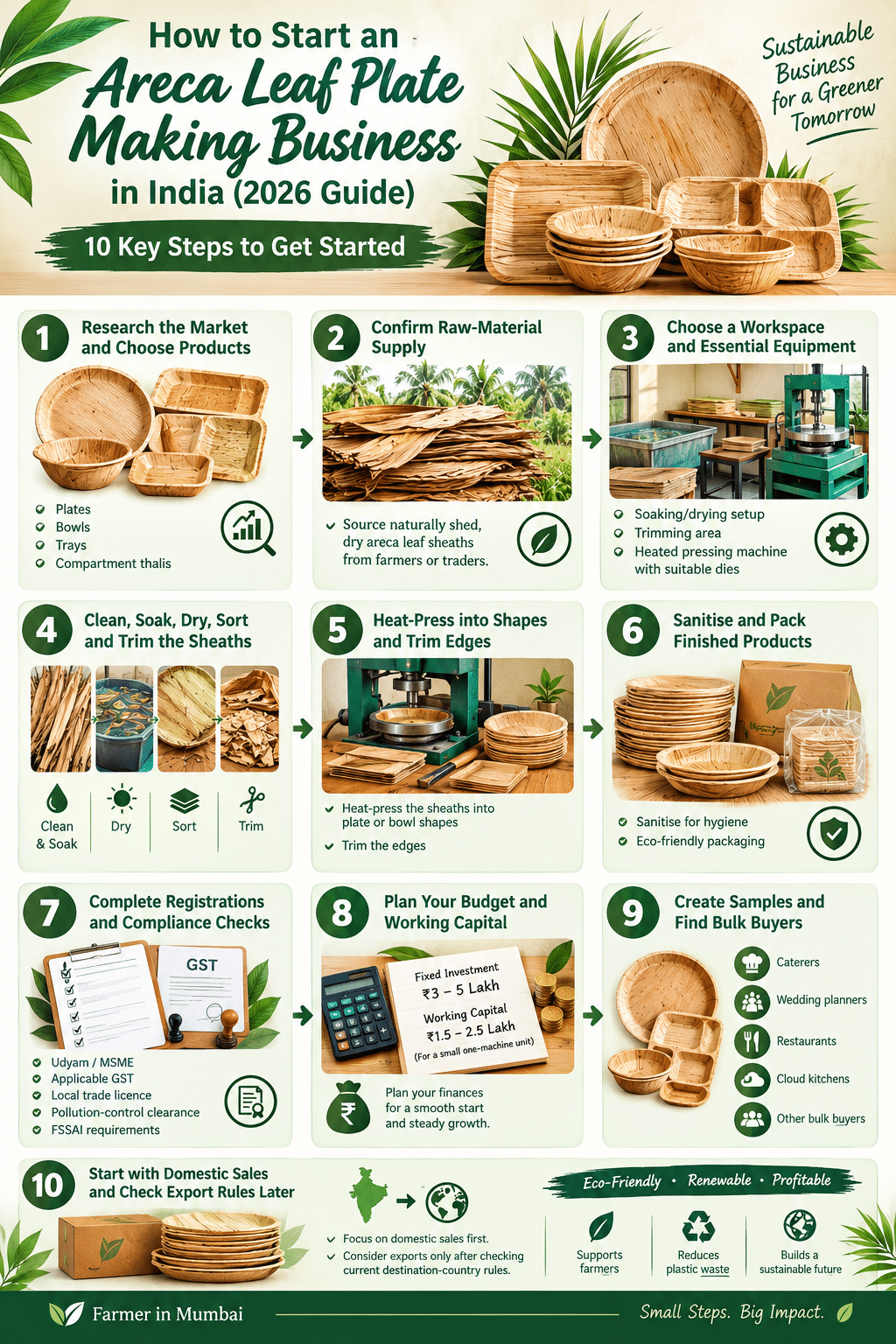
The process is simple and mostly manual. Here are the steps:
- Collect: Buy fallen, dry areca sheaths from farmers or local traders.
- Clean and soak: One project report says the sheaths are washed and soaked in water for about 15 minutes, then dried in the shade for around 30 minutes.
- Sort and trim: Remove damaged pieces and cut the sheath to the plate size.
- Press with heat: The sheath goes between two dies. In a typical machine, the upper aluminium die is heated electrically and the sheath is pressed against the lower die. This gives the plate its shape.
- Trim the edges: Cut or smooth the edges for a neat finish.
- Sanitise and pack: Many units clean the finished plates and then pack them in bundles of 25, 50 or 100.
Products you can make with different dies: round, square and oval plates, bowls, compartment thalis, trays and cups. Some dies can also make spoons. A government tender for one multi-die machine lists areca leaf plates, containers and spoons. Ask the machine seller to show you a demo of the exact item you want.
3. What Is the Target Market?
Your customers are mostly businesses that use plates in large numbers:
- Caterers and wedding planners (your biggest buyers)
- Restaurants, cafes, cloud kitchens and food trucks
- Sweet shops, street food stalls and tiffin services
- Temples, trusts and community events that serve food to many people
- Hotels, resorts and corporate cafeterias that want a “green” image
- Eco-friendly stores and online shoppers who buy small packs (for example, 25 plates)
- Exporters and traders who buy in bulk
India is a big player here. One report says the global market for areca plates and cups is about ₹3,500 crore a year, and India holds a share of around ₹2,500 crore.
4. How to Generate Leads for Your Plates
Selling is where most small units struggle. Here is a simple plan:
- Make samples first. Give 20 to 25 free plates to 10 caterers. Ask for honest feedback.
- Show strength on video. Pour hot curry on a plate and film it. Post it on Instagram Reels and YouTube Shorts. People trust what they can see.
- List your unit on IndiaMART and TradeIndia. Many bulk buyers search there.
- Use WhatsApp Business. Add a catalogue with sizes, prices and minimum order quantity.
- Create a Google Business Profile. Local buyers search “areca plates near me.”
- Meet wedding planners and catering groups in your city. One regular caterer can buy thousands of plates a month.
- Sell small packs online. Use Amazon, Flipkart or your own website for 25-plate and 50-plate packs. Margins are higher.
- Ask for repeat orders. Offer a small discount for monthly supply.
5. Initial Capital Investment
The biggest cost is the machine. Prices vary by die count and automation. One seller lists a 5 kW semi-automatic machine in the range of ₹1.04 lakh to ₹2.65 lakh, making about 1,500 to 2,000 plates per shift. Another listing shows a machine at ₹2.45 lakh, with extra plate dies at about ₹10,000 each. Also, a Tamil Nadu government project note for a small areca plate unit is built around a project cost of ₹5 lakh.
Estimated budget for a small unit (my estimate):
| Item | Approx. cost |
| Plate making machine | ₹1.5 – ₹2.7 lakh |
| Extra dies (different sizes) | ₹20,000 – ₹40,000 |
| Soaking tank, drying racks, trimming table | ₹30,000 – ₹50,000 |
| Shed, electrical work (if you don’t have space) | ₹30,000 – ₹60,000 |
| Registrations and licences | ₹5,000 – ₹15,000 |
| Total fixed investment | ₹3 – ₹5 lakh (approx.) |
6. Working Capital Requirement
Working capital is the money you need to keep the unit running. Raw material is the biggest part. One industry report says sheaths make up around 40 to 50 percent of total operating cost.
You need money for:
- Buying sheaths (often in bulk, in the season when supply is good)
- Wages, electricity and packing material
- Transport
- Credit given to buyers (many bulk buyers pay in 15 to 30 days)
Rough estimate: keep ₹1.5 – ₹2.5 lakh as working capital for a one-machine unit. That covers about two months of stock plus running costs.
So, total money needed: roughly ₹4.5 – ₹7.5 lakh.
7. Labour Requirement
This is a small-team business. One project report says each areca plate unit employs about three people directly. A simple setup looks like this:
- 1 machine operator (often the owner at the start)
- 1 helper for cleaning, soaking and drying the sheaths
- 1 packer or trimmer (can be part-time at first)
Training takes only a few days. The skill is in judging the sheath quality and handling the heat and pressure correctly. Women and local rural workers can do this work well, so it is a good fit for small towns near areca-growing regions.
8. Export Potential (Read This Carefully)
India is the world’s biggest producer, and exports have been a big part of the business. But there is an important change you must know.
The US market is currently blocked. The US FDA issued Import Alert 23-15. It classifies areca-based bowls, plates, cups and cutlery as unsafe food additives, so they cannot lawfully be sold in the US. The FDA’s alert page shows an updated date of 23 March 2026, and a review from August 2026 says the products remain subject to the alert. Reports also say Canada and Australia have similar restrictions.
The impact has been serious. In one Karnataka region, about 12 lakh of the 25 lakh plates made each month had been going to the US.
What this means for you:
- Do not plan your business around US exports. Many online listings still say “USA,” but check the current rules yourself.
- Other markets exist. Government trade data shows Indian areca dinnerware going to the UK, Netherlands, Germany and Sweden. Middle East buyers are also commonly mentioned by exporters.
- Start with the domestic market. Add exports later, through experienced exporters, after you have stable quality and test reports.
- Before any export, check the import rules of the destination country, get an IEC (Import Export Code), and ask your buyer what test reports they need.
9. Government Rules and Regulations
Rules depend on your state and the size of your unit. These are the usual things to check:
- Udyam (MSME) registration: Free and simple. It helps with loans and schemes.
- GST registration: Needed once you cross the turnover limit or sell across states. The GST rate on areca plates has been debated. A 2018 Karnataka ruling said areca plates were taxable at 2.5% CGST plus 2.5% SGST, while another source says genuine leaf plates are nil rated. Rates change, so confirm the current rate with a CA before you start billing.
- Shop or trade licence from your local body.
- State Pollution Control Board: A small, dry unit like this is usually low-impact, but ask your local office whether you need consent.
- FSSAI: Plates touch food, so large buyers may ask for an FSSAI registration or lab test reports. Ask your local FSSAI office whether you need a licence, and keep a test report ready.
- Electricity connection: Get the right commercial or industrial connection for the machine.
- Single-use plastic rules: India has banned many single-use plastic items, which helps your demand. Check your state’s rules for the latest list.
- Loan and subsidy schemes: Look at PMEGP, Mudra loans and your state’s MSME schemes. Check the official portals for current eligibility.
10. Future Potential
The future looks good at home, with a few cautions.
Reasons to be positive:
- People and governments are moving away from single-use plastic.
- Weddings, catering and food delivery keep growing.
- Raw material is agro-waste, so it fits the “zero waste” story.
- Rural and small-town entrepreneurs can start with low capital.
Things to watch:
- Export rules can change quickly, as the US case shows.
- Too many small units can push prices down for plain plates.
- Sheath supply is seasonal and can be costly outside areca-growing regions.
How to stay ahead: Add bowls, trays, compartment thalis and cups. Build your own brand. Sell direct to caterers, and keep a second material (such as bagasse or bamboo) in mind if rules change.
11. Profitability: How Much Can You Earn?
Here is a simple example. These numbers are my assumptions, not a guarantee. Check your local plate prices before you decide.
Assumptions: one machine, 1,500 plates a day (the lower end of one machine’s listed range), 25 working days a month = 37,500 plates a month. Average selling price: ₹2.50 per plate (wholesale).
| Item | Owner-run (owner + 1 helper) | Fully hired team (3 workers) |
| Sales | ₹93,750 | ₹93,750 |
| Raw material (about ₹0.75 per plate) | ₹28,125 | ₹28,125 |
| Wages | ₹12,000 | ₹36,000 |
| Power, repairs, dies | ₹7,500 | ₹7,500 |
| Packing and transport | ₹7,500 | ₹7,500 |
| Shed rent | ₹8,000 | ₹8,000 |
| Monthly profit (before loan interest and marketing) | about ₹30,000 | about ₹6,600 |
What to learn from this table:
- Your own involvement makes a big difference at the start.
- A second machine helps, because the same team can produce more plates.
- Price matters. If the plate price falls to ₹2, profit drops sharply.
- Higher-value products (compartment plates, bowls, branded small packs) earn more per piece.
- With the owner-run example, payback on a ₹4 to ₹5 lakh investment could be around 1.5 to 2 years. Larger plants take longer. One report for bigger plants says break-even is usually 3 to 6 years.
Quick Checklist Before You Start
- Visit 2 or 3 existing units and watch a live demo.
- Get written quotes from at least 3 machine makers.
- Confirm sheath supply and price within 100 to 200 km of your unit.
- Make 500 sample plates and show them to 10 buyers.
- Register on Udyam, and confirm GST, licence and pollution rules locally.
- Plan for domestic sales first. Treat exports as a bonus.
Frequently Asked Questions
How much does it cost to start an areca leaf plate business?
A small one-machine unit needs about ₹3 to ₹5 lakh for machine and setup, plus ₹1.5 to ₹2.5 lakh as working capital. Your total may be ₹4.5 to ₹7.5 lakh.
Can I start it from home?
You need space for soaking, drying, pressing and storing, and the machine uses a lot of power. Many people use a small shed or rented room. Check your society or local rules before you run a machine at home.
Is the areca leaf plate business profitable?
It can be, especially if you run the machine yourself and sell directly to caterers. Margins on plain plates are thin, so quality, regular supply and good buyers matter.
Can I export areca leaf plates to the USA?
Not at present. The US FDA has an import alert on areca leaf dinnerware, and Canada and Australia are also reported to restrict it. Check the latest rules before any export plan.
Do I need a licence?
Usually you need Udyam registration, GST (once applicable), a local trade licence, and a check with your pollution control board and FSSAI office. Rules differ by state, so confirm locally.
Where do I buy raw material?
Mostly from areca-growing areas such as Karnataka, Kerala, Assam and parts of Tamil Nadu and West Bengal. Ask local farmer groups and traders for dry sheaths.
Final Words
The areca leaf plate business is a real, low-cost manufacturing idea with strong local demand. It is not a get-rich-quick plan. Start small, learn the machine, find 5 to 10 steady buyers, and grow from there. Treat export news as a warning to diversify, not a reason to wait.
Planning to start? Tell us in the comments which part worries you most: machine, raw material or finding buyers.

Akhilesh Maurya
Administrator at Farmer In Mumbai
- 15 Best Microgreens To Grow At Home In Your Balcony : A DIY guide
- 12 Indoor Vastu Plants for Home in Mumbai With Direction And Pot Guide
- 10 Private Terrace Garden Ideas For Mumbai, Navi Mumbai And Thane Residents With Rules And Regulations
- How to Make Self Watering Pots at Home : 3 Easy DIY Methods
- How To Use Cocopeat For Plants : A Complete DIY Guide
- Balcony Garden Rules And Regulations In Mumbai Housing Societies
- Compost Bin For Kitchen Waste And Garden : A DIY Guide to Make, Buy and Use It
- Laid Off or Burned Out? 6 Small Garden Business Ideas You Can Start For Under ₹15,000
- Get Pesticide Free Vegetables Near Me in Mumbai: How to Verify Before You Buy
- 7 DIY Methods To Get Rid Of Mealybugs On Plants Naturally
- 10 Plants For North Facing Balcony In Mumbai, Thane And Navi Mumbai High Rise Buildings
- Best Soil Mix for Indoor Plants in Mumbai: A Plant-by-Plant Guide