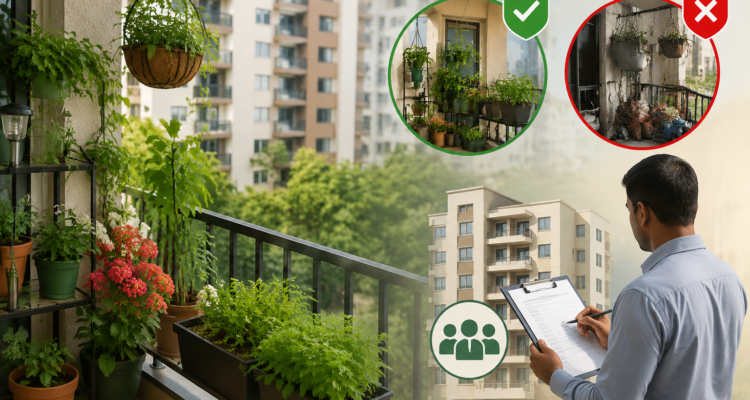
Do you love your balcony garden, but worry about balcony garden rules and regulations? You are not alone. Almost every plant lover in a Mumbai housing society has this doubt at some point. The good news is, balcony gardening is allowed almost everywhere. But a few rules do apply, and it helps to know them before you fill your balcony with pots.
In this guide, we will explain this in plain and simple words. No legal jargon, just what you actually need to know — including what changed under the new 2026 state rules, and the real disputes residents in Mumbai, Thane, and Navi Mumbai are actually running into right now.
What Are Housing Society Bye-Laws, In Simple Words
Every registered housing society in Maharashtra follows a set of rules called bye-laws. These come from the Maharashtra Co-operative Societies Act, and every society adopts its own version based on a model template set by the government. You can read the official Model Bye-Laws document from the Maharashtra Cooperation Department if you want to see the exact wording. A simpler, searchable version is also available on MySocietyClub’s bye-laws page, which covers rules around flat maintenance and alterations.
These bye-laws mostly talk about maintenance, safety, and keeping the building looking neat. They are not written to stop you from gardening. They are written to stop unsafe or unauthorised changes to the building structure.
Can Your Society Stop You From Balcony Gardening?
In short, no. No society can stop you from keeping pots and plants on your own balcony. Gardening on your own private space is your right as a flat owner. What societies can do is set some reasonable conditions, mostly around safety and shared spaces.
Problems usually start not because of gardening itself, but because of things like:
- Water dripping onto the balcony below
- Pots kept on the outer ledge, which can fall during strong wind or monsoon
- Heavy tubs on old or weak slabs
- Soil or leaves blocking common drains
If you avoid these five issues, you will almost never have a conflict with your society.
What Societies CAN Reasonably Ask You To Do
- Use drip trays under every pot so water does not fall on neighbours
- Avoid hanging pots outside the railing without a proper stand or bracket
- Keep the total weight within safe limits, especially on older buildings
- Clean up fallen leaves and soil so common areas stay tidy
- Take permission before making any structural change, like enclosing the balcony
None of these rules are against gardening. They simply ask you to be a good neighbour.
What Societies CANNOT Legally Stop You From Doing
- They cannot stop you from keeping plants inside your own balcony
- They cannot force you to remove pots without a valid safety reason
- They cannot charge you extra just because you have a garden
- They cannot single you out if other flats have similar setups too
If a society tries to do any of these without a genuine safety reason, it usually goes beyond what the bye-laws actually allow.
What Changed Under the 2026 MCS Amendment Rules
If you’ve read any housing-society news recently, you’ve probably seen mentions of the Maharashtra Co-operative Societies (Amendment) Rules, 2026, which were notified on 18 June 2026 and came into effect on 30 June 2026. This is worth a quick clarification, because a lot of residents assume it changed something about balcony gardening specifically — it didn’t.
These new rules add a dedicated chapter to the Maharashtra Co-operative Societies Rules, 1961, covering things like how much societies can charge, how general body meetings are conducted, and how flat transfers and redevelopment are handled. They apply to roughly 1.27 lakh housing societies across the state, including about 33,200 in Mumbai alone, so it’s a genuinely big update — just not one that adds or removes any gardening-specific restriction.
What the update does reinforce is that decisions taken at a general body meeting are binding on all members, including any resolution about balcony plants. So if your society wants to restrict balcony gardening, that restriction still needs to come from an actual passed resolution, not a one-line instruction from the secretary. This was already true before the 2026 amendment, and remains true after it.
Good to know: if your committee cites “new government rules” as the reason for a fresh balcony restriction, it’s worth politely asking to see the specific rule or resolution in writing. The 2026 amendment does not create any new gardening restriction on its own.
The Real Reason Behind Stricter Pot Rules: A Safety Incident, Not a New Law
Many Mumbai, Thane, and Navi Mumbai residents have noticed their societies getting stricter about pots on railings and ledges over the past year or so. This isn’t random — it traces back to a tragic incident in a Pune high-rise, where a flower pot fell from a balcony and fatally struck a child playing below. CCTV footage of the incident went viral, and in the aftermath, several Resident Welfare Associations across Maharashtra and the NCR issued advisories asking residents to remove pots from balcony edges and hanging brackets entirely, rather than just securing them.
This context matters, because it explains why some societies now ask for pots to be removed even when they were never a real hazard. The underlying safety concern is genuine and worth taking seriously, especially in buildings with young children playing below. But a blanket “no pots on the railing” rule and a well-secured pot with a proper bracket and drip tray are not the same risk — and it’s reasonable to make that distinction to your committee rather than accept an outright ban.
A Quick Note on Balcony Enclosures
Many Mumbai flats have glass or grille enclosures on the balcony. If you are thinking of closing your balcony completely, that is a structural change, and it does need society and sometimes BMC approval. Gardening rules and enclosure rules are two very different things, so do not mix them up. Simply keeping plants needs no permission at all.
Water Leakage From Balcony Plants: The Most Common Real Dispute
Across resident forums, legal advice columns, and even consumer court cases, water leakage is by far the most common and most bitter dispute connected to balcony gardening in Mumbai housing societies — far more common than disputes about whether plants are allowed at all.
The usual pattern: a flat owner waters their plants, excess water seeps through the balcony floor or drips onto the flat or common area below, and it snowballs into a long-running complaint. Bye-laws generally place internal leakage, like water from your own bathroom or improperly sealed balcony floor, on the flat owner to fix, while external or structural leakage, like a cracked terrace slab or an ageing common wall, is the society’s responsibility. In practice, residents report these lines get disputed for years, sometimes stretching to five or six years of unresolved damp, fungus, and even health complaints for the family below.
The good news is that this is also the easiest dispute to prevent, since the fix is entirely within your control:
- Use a saucer or drip tray under every single pot, and check it doesn’t overflow after heavy watering
- Avoid overwatering, especially just before you leave the house for the day
- Check your balcony floor’s waterproofing periodically, especially before monsoon
- If a downstairs neighbour does complain, address it immediately and in writing — a quick, cooperative response is what keeps this from becoming a formal society dispute
If a leakage dispute does escalate despite your best efforts, and the cause turns out to be a structural or external issue rather than your watering habits, you can ask the committee to reference the relevant bye-law and, if needed, escalate to the Cooperative Court under the standard dispute process — but this is rarely necessary if drip trays and mindful watering are in place from day one.
Older Buildings and Structural Audits: Do Weight Limits Apply to You?
If you live in an older building in Mumbai, Thane, or Navi Mumbai, there’s a legitimate, separate reason your society might ask you to keep balcony weight down: structural audits. Under the Model Bye-Laws, buildings between 15 and 30 years old need a structural audit once every 5 years, and buildings older than 30 years need one every 3 years. Navi Mumbai’s municipal corporation alone flagged 527 buildings as “dangerous” in a recent citywide survey, which gives a sense of how real this concern is in the region, not just theoretical caution.
If your building has recently gone through a structural audit, it’s worth asking your committee whether the report includes any specific balcony load guidance, rather than accepting a vague, blanket restriction. In the meantime, a simple, low-friction habit for anyone in an older building is to prefer lightweight plastic or fibre pots over heavy concrete or ceramic ones, and to spread pots out rather than clustering them in one corner of the balcony.
How To Avoid Any Conflict With Your Society
Here is a simple, consultative approach we recommend to our clients in Mumbai:
- Talk to your secretary informally before you start, just to keep things friendly
- Use saucers or trays under every single pot
- Choose lightweight pots wherever possible, especially on higher floors or older buildings
- Keep your garden within your own balcony boundary
- Avoid overloading one corner with heavy tubs, spread the weight instead
This small effort builds goodwill, and most societies are actually happy to see a well-kept balcony garden. It adds to the building’s look too.
Choosing The Right Plants Also Reduces Conflict
A well-planned balcony garden creates fewer problems in the first place. If your balcony faces strong sun and monsoon spray, our guide on monsoon-proof plants for Mumbai balconies will help you pick plants that do not create mess or water overflow. If your space is small, these Mumbai terrace garden ideas for small spaces show you how to keep things neat and compact.
Drainage is usually the biggest cause of society complaints. Our post on how to stop waterlogging in a Mumbai terrace garden covers this in detail, so your neighbours downstairs never have a reason to complain. And if your pots often develop fungus in our humid weather, this guide on fungus and root rot treatment for Mumbai’s climate will help you fix it early.
Frequently Asked Questions
Updated with new problem-and-solution entries based on real disputes reported by Mumbai, Thane, and Navi Mumbai residents.
Can my society force me to remove my balcony plants?
Not without a genuine safety reason, like a weak slab or water leaking into a neighbour’s flat.
Do I need society permission to start a balcony garden?
No, keeping pots on your own balcony does not need any formal permission. It is a good idea to inform your secretary, just to stay on friendly terms.
Is hanging pots outside the railing allowed?
This is usually the most sensitive rule. Many societies ask you to avoid it for safety, especially on higher floors. Use a proper bracket or keep pots inside instead.
What if my society still objects unfairly?
You can politely refer them to the official Maharashtra Cooperative Societies bye-laws, and explain that gardening on your own balcony is a private right, as long as safety rules are followed.
Did the new 2026 Maharashtra housing society rules change anything about balcony gardening?
Problem: You’ve heard about the new MCS Amendment Rules, 2026 and worry your society now has fresh legal grounds to restrict your plants.
Solution: No gardening-specific restriction was added by the 2026 amendment. It reorganises rules around society charges, meetings, and redevelopment. Any balcony restriction still needs to come from an actual general body resolution, exactly as before. If your committee cites “new rules” for a plant ban, ask to see the specific resolution in writing.
My society suddenly wants all pots removed from railings after a safety scare — is this legal?
Problem: Following news of a child injured or killed by a falling pot elsewhere in Maharashtra, some societies issue blanket bans on any pot near a railing or edge, even well-secured ones.
Solution: Societies can reasonably restrict unsecured hanging pots for safety. But a pot secured with a proper bracket and drip tray is a different risk profile from one balanced loosely on a ledge. It’s reasonable to show your committee your setup and ask that safety compliance, not a blanket ban, be the standard — especially since the bye-laws don’t allow societies to single out compliant members without cause.
My downstairs neighbour is complaining that my plant watering is leaking into their flat. What now?
Problem: This is the single most common real dispute connected to balcony gardening, and it can escalate quickly if not addressed.
Solution: Add or check drip trays under every pot immediately, and reduce watering volume, especially right before you leave home. Respond to your neighbour in writing to show good faith. If the leakage continues despite this, ask your society to check whether it’s actually a structural issue (cracked slab, old waterproofing) rather than your watering, since bye-laws generally place structural leakage on the society, not the flat owner.
I live in an older building — are there weight limits for my balcony garden?
Problem: Buildings over 15 years old in Mumbai, Thane, and Navi Mumbai require periodic structural audits, and some residents worry their pots could be a load risk.
Solution: Ask your committee whether your building’s most recent structural audit report includes any specific balcony load guidance. If you’re unsure or the audit is overdue, the safe, low-effort habit is to switch to lightweight plastic or fibre pots instead of concrete or ceramic ones, and to spread pots across the balcony rather than clustering them in one corner.
Need help planning a society-friendly balcony garden? Get in touch with Farmer In Mumbai and we will help you choose the right plants and setup for your building.

Akhilesh Maurya
Administrator at Farmer In Mumbai
- 15 Best Microgreens To Grow At Home In Your Balcony : A DIY guide
- How to Start an Areca Leaf Plate Making Business in India (2026 Guide)
- 12 Indoor Vastu Plants for Home in Mumbai With Direction And Pot Guide
- 10 Private Terrace Garden Ideas For Mumbai, Navi Mumbai And Thane Residents With Rules And Regulations
- How to Make Self Watering Pots at Home : 3 Easy DIY Methods
- How To Use Cocopeat For Plants : A Complete DIY Guide
- Compost Bin For Kitchen Waste And Garden : A DIY Guide to Make, Buy and Use It
- Laid Off or Burned Out? 6 Small Garden Business Ideas You Can Start For Under ₹15,000
- Get Pesticide Free Vegetables Near Me in Mumbai: How to Verify Before You Buy
- 7 DIY Methods To Get Rid Of Mealybugs On Plants Naturally
- 10 Plants For North Facing Balcony In Mumbai, Thane And Navi Mumbai High Rise Buildings
- Best Soil Mix for Indoor Plants in Mumbai: A Plant-by-Plant Guide