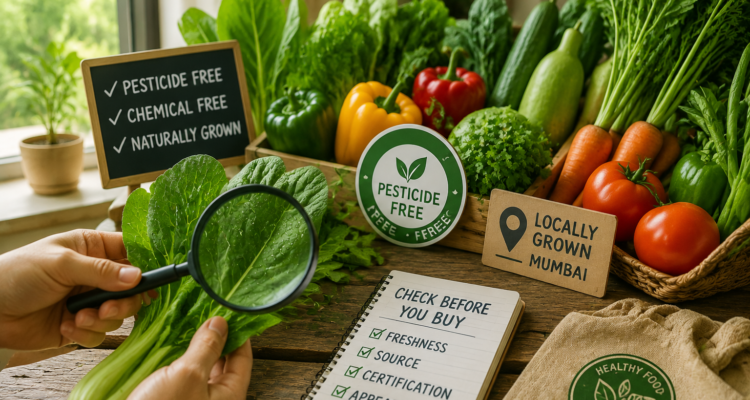
If you’ve typed “pesticide free vegetables near me in Mumbai” into Google at 8 pm while planning tomorrow’s sabzi run, you’re not alone. Between the mandatory “organic” stickers at supermarkets, the sabziwala who swears his produce is “bilkul natural,” and the WhatsApp forwards about injected watermelons, it’s genuinely hard to know what’s landing on your chopping board.
Here’s the honest truth first: there is no 100% reliable way to confirm pesticide residue using only kitchen materials. Real pesticide testing needs a lab, a chromatograph, and a technician — not your kitchen counter. But that doesn’t mean you’re powerless. What you can do with things already in your kitchen is:
- Spot common red flags that suggest heavy chemical treatment
- Meaningfully reduce whatever residue is present before you cook
- Buy from the right sources in the first place, so testing matters less
This guide covers all three — plus the best pesticide-free markets across Mumbai, Navi Mumbai, and Thane, and the online stores worth ordering from.
Why “Pesticide-Free” Is Hard to Verify by Sight Alone
Mumbai’s vegetable supply chain is long — most produce travels from Nashik, Pune, Satara, Palghar, or Gujarat farms through the Vashi APMC market before it reaches your local vendor. Along the way, it may pick up:
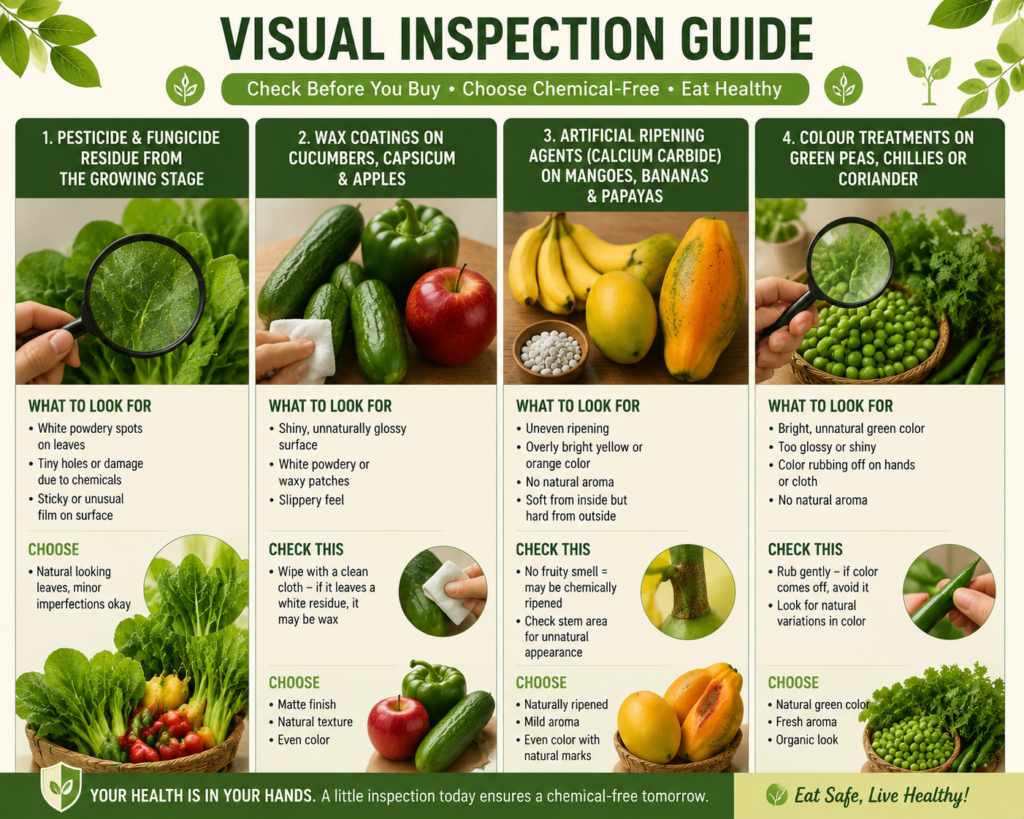
- Pesticide and fungicide residue from the growing stage
- Wax coatings on cucumbers, capsicum, and apples to extend shelf life
- Artificial ripening agents (like calcium carbide) on mangoes, bananas, and papayas
- Colour treatments on green peas, chillies, or coriander to make them look fresher
None of these show up reliably to the naked eye — which is exactly why “it looks fresh and green” isn’t proof of anything.
DIY Checks You Can Do in a Mumbai Kitchen
These are indicative checks, not lab-grade tests. Think of them as red-flag detectors — if a vegetable fails one of these, it doesn’t confirm pesticide contamination, but it’s a good reason to buy from a different source next time.
1. The Warm Water Wax Test
Waxed vegetables (common with cucumbers, capsicum, brinjal, and bottle gourd) often get an extra coating to hide bruises or ageing, and that coating can trap pesticide residue underneath it.
How to do it: Dip the vegetable in a bowl of warm (not boiling) water for 15–20 seconds and gently rub the skin with your fingers or a soft cloth. A thin, greasy film separating from the skin, or the water turning slightly cloudy, indicates a wax coating.
2. The Salt-Water Soak Test
This won’t detect a specific pesticide, but a strong salt solution is genuinely effective at loosening surface residue and any hidden insects (useful for cauliflower, broccoli, and leafy greens).
How to do it: Mix 2 tablespoons of salt in 1 litre of water. Soak the vegetables for 15–20 minutes, then rinse thoroughly under running water. If you see debris, tiny larvae, or a layer of grit settle at the bottom of the bowl, that’s a sign the produce wasn’t heavily chemically treated (pesticide-treated produce tends to have fewer live insects, ironically).
3. The Vinegar-Baking Soda Combination Wash
This is the single most effective kitchen-level step you can take — not to “detect” pesticide, but to genuinely cut down residue that’s already there. A 2026 scoping review of 47 peer-reviewed studies found that soaking produce in a baking soda or vinegar solution removed noticeably more residue than plain water rinsing across a wide range of pesticides. Independent testing has also found a 1% baking soda soak for 12–15 minutes cleared surface pesticide residue on apples more effectively than a bleach solution or plain rinse.
How to do it:
- Mix 1 teaspoon baking soda in 2 cups of water and soak vegetables for 12–15 minutes, or
- Mix 1 part white vinegar to 3 parts water and soak for 10–15 minutes
- Rinse thoroughly under running water afterwards to remove the vinegar/baking soda taste
Use a wide steel basin or your sink, and a soft brush for firmer vegetables like potatoes, carrots, and ridge gourd.
4. The Cotton Swab Colour Test
Used to catch artificial colouring rather than pesticide, but worth knowing — vendors sometimes coat green peas, coriander, or chillies with malachite green or other dyes to make them look fresher and more vivid.
How to do it: Dampen a small piece of cotton wool or a cotton ball with water and gently rub it on the vegetable’s surface. If the cotton picks up green, yellow, or unnatural colour, the vegetable has likely been dyed.
5. The “Too Perfect” Visual Check
This is a judgement call, not a test — but genuinely organic, pesticide-light produce is rarely picture-perfect. Slight size variation, a few small blemishes, occasional insect bite marks, and irregular shapes are actually good signs. Uniformly glossy, blemish-free vegetables of identical size, especially out of season, are more often a sign of heavy chemical intervention (or cold storage + wax).
6. Ask for the Harvest Date and Farm Source
Not a “test” in the kitchen sense, but the single most useful verification step: a vendor or app that can tell you which farm and when it was harvested is far more trustworthy than one who can’t answer at all. Genuine organic and residue-free sellers are usually happy to share this — it’s their main selling point.
A more reliable option, if you want real proof: Several private labs in Mumbai (and FSSAI-empanelled labs) offer pesticide residue testing for a fee, usually a few hundred rupees per sample, with results in 3–5 days. If you’re buying in bulk for a family with young kids or an elderly person with health concerns, this is worth it occasionally as a spot-check on your regular vendor.
The Right Kitchen Tools Make This Whole Process Easier
You don’t need anything exotic — just a few things that make washing, soaking, and prepping vegetables properly a lot less of a chore. A few picks that pair well with the steps above, available on Farmer In Mumbai:
- ORILEY Multipurpose Hand Water Sprayer — handy for a quick pressure-rinse of leafy greens and herbs after their vinegar or salt-water soak, to wash away loosened residue and dirt.
- SJ Organics Garden Spray Pump — a larger 2L option if you’re washing vegetables in bulk for the week.
- Konvio Digital TDS Meter — while designed for drinking water, it’s a useful way to check that the water you’re using to wash and soak your vegetables is clean to begin with, since washing produce in contaminated water defeats the purpose.
- Vegetable Chopper for Kitchen — makes it easy to slice open vegetables to check the cross-section for discolouration or an unnatural waxy layer before cooking.
- HealthSense Digital Kitchen Weighing Scale — useful if you’re buying from APMC or wholesale markets in bulk and want to double-check what you’re paying for.
- Compost Bin for Kitchen Waste — once you’ve washed, peeled, and prepped, compost the peels and trimmings instead of binning them. If you’re growing even a few vegetables of your own on a Mumbai balcony, this is also the easiest way to close the loop and reduce how often you need to “verify” store-bought produce at all.
(These are affiliate links via Amazon — Farmer In Mumbai earns a small commission at no extra cost to you.)
Best Pesticide-Free & Organic Vegetable Markets Near You
If verification is the hard way, buying closer to the source in the first place is the easier one. Here are the most trusted options across the Mumbai Metropolitan Region.
Mumbai City
D’Monte Park Farmers’ Market (Bandra)
Started in 2010 by Kavita Mukhi, this is widely regarded as one of the original organic markets in the city and is Eco-Cert certified, sourcing from farmer cooperatives around Nashik. Open every Sunday morning.
Juhu Organic Farmers’ Market
A joint initiative with The Inner Wheel Club of Bombay West and the NGO SHARAN, focused on organic and chemical-free produce, herbs, and dairy-free items. Held on select weekends.
Malad Organic Farmers’ Market (HyperCity, Malad West)
Runs every Saturday from 10 am to 2 pm, offering fresh, seasonal, zero-pesticide produce sourced directly from farms, alongside terrace-gardening and pottery workshops.
Navi Mumbai & Thane
APMC Vashi (Vegetable & Fruit Market)
Not organic-certified across the board, but this is the wholesale hub supplying most of Mumbai, Navi Mumbai, and Thane — buying here directly (minimum 5–10 kg per item is typical) cuts out layers of middlemen and lets you buy fresher, cheaper produce that hasn’t sat around for days. Arrive between 4 am and 7 am for the best rates and freshest stock; carry cash or UPI.
Seawoods Farmers’ Market (Seawoods Grand Central Mall, Navi Mumbai)
A twice-weekly market known specifically for chemical-free vegetables, with multiple organic stalls to compare from.
Vashi Weekly Farmers’ Market (MSAMB-organised)
Set up by the Maharashtra State Agriculture Produce Marketing Board specifically to connect farmers directly with consumers, cutting out middlemen. Good for indigenous and seasonal vegetables not always available in regular shops.
Local organic retailers in Thane and Navi Mumbai
Several small organic vegetable retailers operate out of Vashi, Seawoods, and Thane West with home delivery options — worth checking listings on Justdial for the ones currently serving your specific pin code, since smaller vendors change locations more often than the bigger markets.
Money-saving tip: Vegetables are cheapest at wholesale markets like APMC Vashi between 4–7 am, right after the morning arrivals. Buying a mixed 10–15 kg lot directly from a regular trader can knock ₹1–3/kg off the price compared to buying small quantities.
Best Online Websites for Pesticide-Free Vegetables in Mumbai
If visiting a market isn’t practical, these online sellers are well-regarded for genuinely chemical-free produce delivered across Mumbai, Navi Mumbai, and Thane:
- Zama Organics — Farm-to-door vegetables and fruits, often harvested just hours before delivery, with delivery across Mumbai, Navi Mumbai, Pune, and Thane.
- Orgpick — 100% certified organic vegetables with a wide range including indigenous and exotic varieties, plus grocery staples.
- Organic Garden — Certified organic produce on a bi-weekly delivery model, with a ₹500 minimum order.
- Fresh India Organics — Organic fruits and vegetables with no minimum order value, delivering across Mumbai.
- The Farmer — Grows its own organic produce at a family farm in Karjat, sources the rest from trusted farmers, and delivers across Mumbai; also sells at the Versova farmers’ market on Sundays.
- Apni Kirana — Focused specifically on Navi Mumbai and Thane, offering chemical-free vegetables at reasonable, wholesale-adjacent prices.
- Frais Farms — Grows its own vegetables, leafy greens, herbs, and microgreens with a “no harmful chemicals” policy, delivering across Mumbai.
As with any online seller, look for ones that specify their farm location, harvest date, and whether they’re certified organic or “residue-free” (a slightly different, often more realistic claim than 100% organic) — and start with a small trial order before committing to a weekly subscription.
The Bottom Line
You can’t 100% verify pesticide-free vegetables with a kitchen test — no one can, not without a lab. But you can stack the odds heavily in your favour: buy from vendors who’ll tell you where and when it was grown, watch for the visual and touch-based red flags above, and always run your vegetables through a proper baking soda or vinegar soak before cooking, regardless of where you bought them from. Combine that with a trip to one of Mumbai’s genuine organic markets every so often, and you’ll be eating noticeably cleaner without needing a chemistry degree to do it.
Looking to grow a few of your own pesticide-free vegetables on your Mumbai balcony instead of second-guessing the sabziwala? Browse gardening tools, seeds, and containers at Farmer In Mumbai →

Akhilesh Maurya
Administrator at Farmer In Mumbai
- 15 Best Microgreens To Grow At Home In Your Balcony : A DIY guide
- How to Start an Areca Leaf Plate Making Business in India (2026 Guide)
- 12 Indoor Vastu Plants for Home in Mumbai With Direction And Pot Guide
- 10 Private Terrace Garden Ideas For Mumbai, Navi Mumbai And Thane Residents With Rules And Regulations
- How to Make Self Watering Pots at Home : 3 Easy DIY Methods
- How To Use Cocopeat For Plants : A Complete DIY Guide
- Balcony Garden Rules And Regulations In Mumbai Housing Societies
- Compost Bin For Kitchen Waste And Garden : A DIY Guide to Make, Buy and Use It
- Laid Off or Burned Out? 6 Small Garden Business Ideas You Can Start For Under ₹15,000
- 7 DIY Methods To Get Rid Of Mealybugs On Plants Naturally
- 10 Plants For North Facing Balcony In Mumbai, Thane And Navi Mumbai High Rise Buildings
- Best Soil Mix for Indoor Plants in Mumbai: A Plant-by-Plant Guide