You should follow BMC Rules And Regulations For Buildings, if you grow plants on your balcony garden or terrace garden in Mumbai, Thane, or Navi Mumbai. There is important news for you. The Bombay High Court has passed an order about flat alterations. This order also touches balconies and terraces that we use for gardening. Many home gardeners do small changes without knowing the rules. This post explains what happened, and what you should and should not do.
What Did the Bombay High Court Say?
On 13 July 2026, the Bombay High Court gave an order in the case Ravindra Kini vs Municipal Commissioner, Panvel Municipal Corporation. The bench had Justice A.S. Gadkari and Justice Kamal Khata.
Here is the simple version:
- The court told the Maharashtra Government to make clear rules about what changes flat owners can make. This includes balconies and terraces.
- The court said people often enclose open terraces, add rooms, or put up partition walls without permission. This can be unsafe for the building.
- The court said “others are also doing it” is not a valid excuse. Every person must follow the rules equally.
- The court suggested an online portal. Residents can upload photos and plans of their proposed changes. This will help people know if they need permission.
- These rules will apply across Maharashtra. So they cover the Municipal Corporation of Greater Mumbai (MCGM), Thane Municipal Corporation (TMC), and Navi Mumbai Municipal Corporation (NMMC).
The final guidelines are still being framed by the government. But the message is clear. Unauthorised changes to your balcony or terrace can invite action. Gardeners must be extra careful.
Why Should Balcony Gardeners Care?
You may think, “I only grow tomatoes and marigolds. Why does a court order about buildings affect me?”
Here is why it matters. Many gardening activities involve small structural changes. For example:
- Fixing a railing planter with drilled bolts
- Adding a shed net or roof sheet to protect plants from rain
- Building a raised bed with bricks or cement
- Closing part of an open balcony with mesh or glass to protect plants from wind
- Adding heavy soil, pots, or a small pond for water plants
Some of these acts can be seen as “alteration” under municipal rules. Gardeners often do this without bad intention. But it can still break the rules. This guide will help you avoid mistakes.
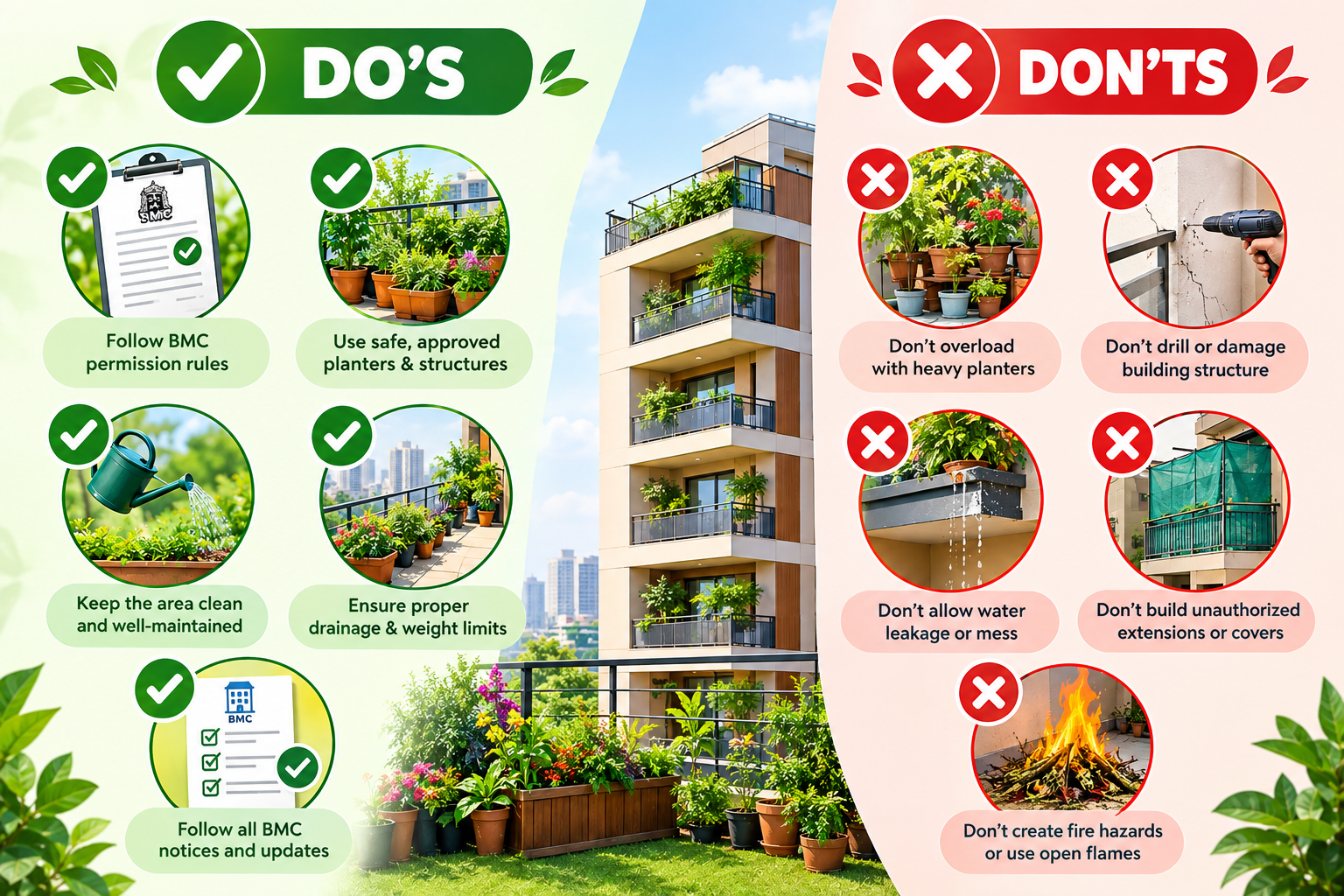
DIY Guide: What Gardeners CAN Do
These are generally low-risk activities. They do not usually change the structure of the building.
- Use movable pots and planters. Place them directly on the floor of your balcony. Do not drill or fix them permanently.
- Use lightweight railing planters that hook on, not bolt on. Hook-style planters can be removed easily without harming the railing.
- Use a drip tray under every pot. This stops water from seeping into walls and floors. It protects you from disputes with your housing society and housing society rules.
- Grow vertical gardens using free-standing frames. A frame that stands on its own, without attaching to the wall or railing, is safer.
- Use shade nets that are tied, not nailed. A net tied with rope can be removed in minutes. This is different from a fixed sheet roof.
- Keep total weight within safe limits. Talk to your society’s structural engineer if you plan many large pots. Overloading a balcony slab is a real safety issue, not just a legal one.
- Check with your housing society first. Before you do any bigger DIY project, ask your managing committee. Many societies already have their own balcony rules.
DIY Guide: What Gardeners Should NOT Do
These are the common mistakes. They may unknowingly break Municipal Corporation rules or go against the spirit of the High Court’s order.
- Do not enclose an open balcony or terrace with permanent sheets or glass. The court has clearly flagged terrace and balcony enclosures as a major issue.
- Do not build brick or cement raised beds on the balcony floor. This counts as a structural change. It needs permission.
- Do not drill into the main structural railing or slab to fix heavy planters, trellises, or pergolas.
- Do not add a fixed roof or shed over your balcony for a “kitchen garden,” even if it looks temporary. Fixed roofing was named as a common problem area.
- Do not remove or cut the existing safety railing to make more planting space. This is unsafe and against building rules.
- Do not connect new plumbing lines or drainage points into the building’s water or drainage system without checking with your society and plumber.
- Do not assume it is fine because your neighbour already did it. The court has clearly said that other people’s violations are not an excuse.
Common “Accidental” Mistakes Mumbai Gardeners Make
Most gardeners do not intend to break any law. But these small habits can cause big problems:
- Overloading the balcony with too many large pots, without checking the weight the slab can take.
- Using cement or adhesive to fix decorative items to the railing or wall, thinking it is only “decoration.”
- Installing a tin or asbestos sheet “temporarily” during monsoon, and then forgetting to remove it.
- Letting a vertical garden frame lean on or attach to a shared wall, which may need the neighbour’s or society’s consent too.
- Growing large fruit trees in big cement tubs on upper-floor balconies, adding heavy, permanent-feeling weight.
A Simple Checklist Before You Start Any Balcony Garden Project
- Is the item movable, or is it fixed permanently?
- Does it involve drilling, cementing, or welding?
- Does it block or reduce the safety railing?
- Does it add roofing or walls where there were none?
- Have you informed your housing society?
- Have you checked the total weight with someone who understands structural load?
If you answer “yes” to drilling, cementing, roofing, or blocking the railing, pause and check with your society or a local architect before you proceed.
What Happens Next?
The Maharashtra Government is expected to release detailed guidelines and possibly an online portal for approvals. Until then, it is safest for gardeners to stick to movable, lightweight, and reversible setups. This way your garden stays beautiful, safe, and worry-free, no matter what the final rules say.
Frequently Asked Questions
Is it illegal to have a balcony garden in Mumbai? No. Growing plants on your balcony is not illegal. The concern is only about permanent structural changes, like enclosing the balcony or adding fixed roofing.
Can I put a shade net on my balcony for plants? Yes, if it is tied and removable. A fixed, nailed, or welded shade structure is riskier.
Does this order affect Thane and Navi Mumbai too? Yes. The High Court’s direction is meant to apply across Maharashtra, including areas under Thane Municipal Corporation and Navi Mumbai Municipal Corporation.
What should I do if I already made a permanent change? Speak to your housing society first. You may also want to check with a local architect about regularising it once state guidelines are released.
Related Reading on Farmer in Mumbai
- How to Set Up a Terrace Garden in Mumbai: Beginner’s Guide
- Best Movable Pots and Planters for Small Balconies
- Kitchen Gardening Ideas for Tiny Mumbai Balconies
- Monsoon Balcony Gardening Tips for Mumbai, Thane & Navi Mumbai
- Railing Planters: A Safety Guide for High-Rise Balconies
- How to Talk to Your Housing Society About Gardening Rules
Disclaimer: This post is for general information only, in simple language, based on media reports of the Bombay High Court’s order dated 13 July 2026. It is not legal advice. Please consult your housing society or a lawyer for guidance specific to your building.

Akhilesh Maurya
Administrator at Farmer In Mumbai
- 15 Best Microgreens To Grow At Home In Your Balcony : A DIY guide
- How to Start an Areca Leaf Plate Making Business in India (2026 Guide)
- 12 Indoor Vastu Plants for Home in Mumbai With Direction And Pot Guide
- 10 Private Terrace Garden Ideas For Mumbai, Navi Mumbai And Thane Residents With Rules And Regulations
- How to Make Self Watering Pots at Home : 3 Easy DIY Methods
- How To Use Cocopeat For Plants : A Complete DIY Guide
- Balcony Garden Rules And Regulations In Mumbai Housing Societies
- Compost Bin For Kitchen Waste And Garden : A DIY Guide to Make, Buy and Use It
- Laid Off or Burned Out? 6 Small Garden Business Ideas You Can Start For Under ₹15,000
- Get Pesticide Free Vegetables Near Me in Mumbai: How to Verify Before You Buy
- 7 DIY Methods To Get Rid Of Mealybugs On Plants Naturally
- 10 Plants For North Facing Balcony In Mumbai, Thane And Navi Mumbai High Rise Buildings