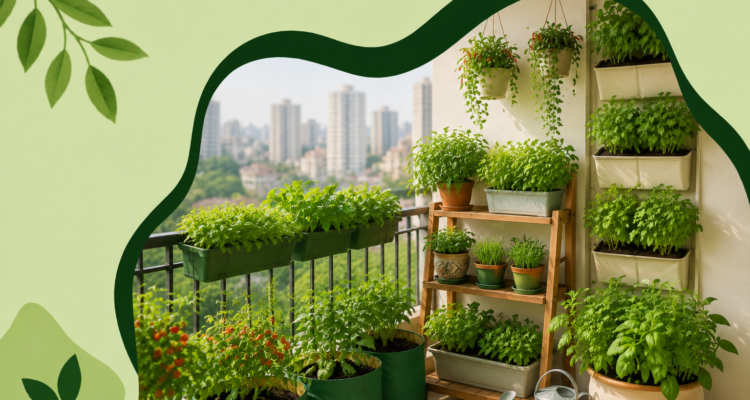
Mumbai kitchen garden is required for growing vegetables and herbs used daily. If you live in a 1BHK or 2BHK in Mumbai, chances are your “outdoor space” is a 3-foot railing, a sunny window grille, or a narrow sliver of a balcony that barely fits a chair — let alone a garden. But that’s exactly enough space to start a productive Mumbai kitchen garden.
You don’t need a terrace or a farmhouse to grow your own tomatoes, coriander, or curry leaves. With the right planters, the right soil mix, and a watering routine that respects Mumbai’s brutal humidity and monsoon swings, even a narrow railing can quietly feed your kitchen through the week.
This guide covers exactly that — garden designs that fit small Mumbai flats, which everyday vegetables and spices are actually worth growing, what planters to buy, how to water each season, and which soil and fertilizer to use.
If you want more layout ideas beyond what’s covered here, we’ve also put together 7 Mumbai terrace garden ideas for small spaces that pair well with this setup.
Why a Kitchen Garden Makes Sense for Small Mumbai Homes
Mumbai kitchens run on a short, repetitive list of fresh produce — coriander, green chillies, curry leaves, tomatoes, onions — bought in small quantities, almost every other day, because there’s no space to store fresh produce for long in most flats. A compact kitchen garden solves this in a small but real way: fewer trips to the sabzi wala for garnish items, fresher flavour, and zero pesticide residue on the leafy stuff you eat raw or lightly cooked.
The two garden designs below are chosen specifically because they need no floor space — which is the actual constraint in most Mumbai flats, not sunlight or time.
1. Railing Planter Boxes
Railing planter boxes are rectangular troughs that clip or hook directly onto your balcony or grille railing, sitting outside or inside the railing line without taking up any floor space. For Mumbai flats where the balcony floor is already occupied by a washing machine, drying rack, or storage, this is usually the single most practical design.
Why it works for Mumbai homes:
- Uses vertical/railing space that’s otherwise wasted
- Gets 4-6 hours of direct sun on east or west-facing balconies, which is enough for most kitchen herbs and small vegetables
- Easy to detach and move indoors during heavy monsoon spells or cyclonic warnings
Best suited for: coriander, mint, curry leaf (dwarf/potted variety), green chillies, spinach, methi (fenugreek greens), and spring onion.
For more design variations and how to arrange plants by sun exposure, check our detailed terrace and small-space garden ideas post.
2. Hanging Bottle Planters
Hanging bottle planters — upcycled PET bottles or purpose-built plastic bottle planters strung vertically along a wall, grille, or railing — are the most space-efficient option for flats with almost no balcony at all. A single wall can hold 10-15 bottle planters in a vertical garden format.
Why it works for Mumbai homes:
- Costs next to nothing if you’re upcycling used bottles
- Works on grille windows facing the compound, staircase-facing balconies, or even inside a well-lit kitchen window
- Good drainage design prevents the waterlogging that kills most balcony plants in Mumbai’s humidity
Best suited for: coriander, mint, small chillies, cherry tomatoes (in slightly bigger 2-litre bottles), and ajwain (carom) leaves.
Both designs are covered with layout photos in our 7 Mumbai terrace garden ideas guide — worth a look if you’re planning to mix both formats on one balcony.
Vegetables and Spices Worth Growing (Everyday Mumbai Kitchen Use)
Skip the exotic stuff for your first setup. Stick to what actually shows up in a Mumbai kitchen daily or every alternate day — these grow reliably in containers and pay back the fastest in grocery savings:
- Coriander (dhania) – used almost daily as garnish; fast growing, sow every 2-3 weeks for continuous supply
- Curry leaves (kadi patta) – a dwarf potted curry leaf plant is a one-time investment that lasts years
- Green chillies (hari mirch) – compact plant, fruits for months once established
- Mint (pudina) – grows aggressively in containers, ideal for chutneys
- Methi (fenugreek greens) – quick harvest cycle (25-30 days), used in both sabzi and as microgreens
- Spring onion (hara pyaz) – regrows from kitchen scraps, near-zero cost
- Tomatoes (cherry or small local varieties) – need a slightly bigger pot but are worth it for a Mumbai kitchen
- Ajwain leaves (Indian borage/doddapatre) – used in kadha and home remedies, very low maintenance
- Ginger and turmeric – slower growing but doable in a deep railing box if you have the patience
Avoid starting with root vegetables like potatoes or carrots, or heavy vine crops like bottle gourd — they need more depth and space than a railing box or bottle planter can offer.
Which Planters to Use
Matching the planter to the plant’s root depth matters more than the material:
- Railing troughs (24-36 inches long, 6-8 inches deep): best for coriander, mint, spring onion, methi, and green chillies
- Deep railing troughs (10-12 inches deep): needed for tomatoes, ginger, and turmeric
- Terracotta pots (8-10 inch diameter): ideal for a single curry leaf plant — terracotta breathes better and prevents root rot in Mumbai’s humidity
- Upcycled bottle planters (1-2 litre): for mint, coriander, and small chillies in vertical/hanging setups
- Grow bags (fabric, 10-12 inch): a good lightweight alternative to plastic railing boxes, especially for tomatoes, since they drain excess monsoon water better than sealed plastic troughs
Whatever the planter, drainage holes are non-negotiable in Mumbai — without them, monsoon humidity plus daily watering guarantees root rot within weeks.
Watering Method and Cycle by Season
Mumbai’s climate swings hard between bone-dry summer heat, relentless monsoon humidity, and a mild, dry winter — your watering routine needs to change with it, not stay fixed year-round.
Summer (March–May)
- Water once daily, early morning before 8 AM, when the sun is less harsh
- On very hot days, a light second watering in the evening helps, especially for bottle planters, which dry out faster due to smaller soil volume
- Use a fine-rose watering can or spray bottle for leafy greens like coriander and mint to avoid disturbing shallow roots
Monsoon (June–September)
- Cut watering drastically — often just 2-3 times a week, or skip entirely on rainy days
- Move railing boxes and bottle planters slightly under an overhang or indoors during continuous heavy rain to prevent waterlogging
- Check drainage holes aren’t blocked; standing water is the single biggest plant-killer in Mumbai’s monsoon
- Skip fertilizing during peak monsoon weeks — roots absorb poorly in saturated soil
Winter (October–February)
- Water every alternate day, in the morning
- Soil dries slower in Mumbai’s mild winter, so check topsoil with a finger before watering — water only if the top inch feels dry
- This is the best growth season for most kitchen garden vegetables, so keep watering consistent rather than skipping days
Across all seasons, water at the base of the plant, not over the leaves, to avoid fungal issues — Mumbai’s humidity already does most of that work for you.
Soil and Fertilizer to Use
Regular garden mitti compacts quickly in containers and doesn’t drain well — a proper potting mix matters more indoors/on balconies than it would in open ground.
Recommended soil mix:
- A base of cocopeat for moisture retention, mixed with organic potting soil and a portion of compost/vermicompost for nutrition — roughly 40% cocopeat, 40% potting soil, 20% vermicompost works well for most kitchen garden vegetables in Mumbai’s climate
You can find a ready cocopeat block and potting soil fertilizer mix on our shop page: Farmer In Mumbai Shop – Soil & Growing Media
Recommended fertilizers:
- Organic vermicompost – mix into the soil at planting and top up monthly; safest option for leafy greens you’ll eat raw or lightly cooked
- Neem cake powder – doubles as a fertilizer and a natural pest deterrent, useful given how many balcony pests Mumbai’s humidity attracts
- NPK (balanced) – use sparingly, once every 3-4 weeks, mainly for fruiting plants like tomatoes and chillies rather than leafy greens
- Seaweed liquid concentrate – a good monthly foliar spray/root drench for an overall growth boost, especially useful going into winter’s peak growing season
All of these are listed on our shop page: Farmer In Mumbai Shop – Fertilizers & Soil
Getting Started This Week
You don’t need to build the whole setup on day one. A practical way to start:
- Pick one railing (best sun exposure you have) and install 2-3 planter boxes
- Fill with the cocopeat + potting soil + vermicompost mix above
- Sow coriander, mint, and one chilli or tomato plant to start
- Add a wall of hanging bottle planters once the railing boxes are established and you’ve got the watering rhythm down
For more layout combinations — including terrace and grille-based ideas beyond railing boxes and bottle planters — read our full guide: 7 Mumbai Terrace Garden Ideas for Small Spaces.
A Mumbai kitchen garden in a small flat isn’t about growing everything — it’s about growing the five or six things your kitchen actually uses every week, and doing that consistently, season after season.

Akhilesh Maurya
Administrator at Farmer In Mumbai
- 15 Best Microgreens To Grow At Home In Your Balcony : A DIY guide
- How to Start an Areca Leaf Plate Making Business in India (2026 Guide)
- 12 Indoor Vastu Plants for Home in Mumbai With Direction And Pot Guide
- 10 Private Terrace Garden Ideas For Mumbai, Navi Mumbai And Thane Residents With Rules And Regulations
- How to Make Self Watering Pots at Home : 3 Easy DIY Methods
- How To Use Cocopeat For Plants : A Complete DIY Guide
- Balcony Garden Rules And Regulations In Mumbai Housing Societies
- Compost Bin For Kitchen Waste And Garden : A DIY Guide to Make, Buy and Use It
- Laid Off or Burned Out? 6 Small Garden Business Ideas You Can Start For Under ₹15,000
- Get Pesticide Free Vegetables Near Me in Mumbai: How to Verify Before You Buy
- 7 DIY Methods To Get Rid Of Mealybugs On Plants Naturally
- 10 Plants For North Facing Balcony In Mumbai, Thane And Navi Mumbai High Rise Buildings