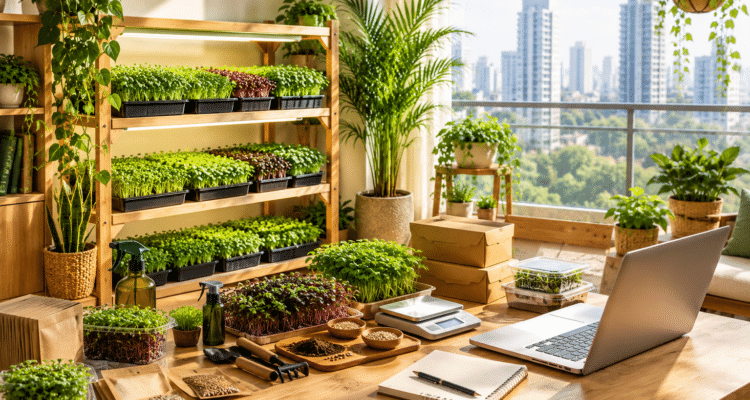
How To Start A Microgreens Business In Mumbai: A Simple DIY Plan (Free Download)
Disclaimer: This post is for learning only. It is not financial or legal advice. Costs and rules change, so please check before you invest. Some links on this site go to products sold on Amazon, and we may earn a small commission at no extra cost to you.
Do you want to start a small business with low money? In this article , you will find microgreens business plan pdf. Do you live in Mumbai, Navi Mumbai or Thane? Then microgreens may be a good idea for you.
Microgreens are tiny baby plants. You harvest them in 7 to 14 days. They need very little space. Chefs, cafes and health-minded families buy them every week.
But many people start this business the wrong way. They buy too much. They grow too much. Then they cannot sell it.
In this guide, I will show you the right way. I will use simple steps. At the end, you can download our free microgreens business plan. It has all the costs, customers, licences and funding details in one place.
Let’s start.
Is Microgreens A Good Business In Mumbai?
Yes, it can be. But it is not a get-rich-quick idea.
Here is the honest truth:
- You need very little space to start.
- You can start with a small pilot at home.
- Restaurants and cafes will pay well for fresh, clean microgreens.
- Profit at a small scale is thin. Profit grows when you get more customers and more trays.
So the best plan is simple. Start small. Learn. Get customers. Then grow.
Step 1: Learn By Growing At Home First
Do not spend lakhs on day one. First, grow a few trays at home. This teaches you how seeds behave in Mumbai’s humid weather.
Read our guide on the 15 best microgreens to grow at home in your balcony. It shows you the taste, growing time and steps for each type.
Try to grow these first:
- Radish (ready in 6 to 8 days)
- Mustard (7 to 9 days)
- Sunflower (10 to 12 days)
- Fenugreek or methi (8 to 10 days)
They are easy and fast. They also sell well.
Step 2: Pick 3 To 5 Varieties To Sell
Do not sell 20 types at the start. Pick a few and do them very well.
A simple mix is:
- Mild and crunchy: sunflower, pea shoots
- Spicy: radish, mustard
- Colour for chefs: red amaranth, beetroot
- Indian kitchen: methi
Want to test many types before buying seeds in bulk? Try the microgreen seeds of 12 varieties pack.
Step 3: Get The Materials
You do not need many things to start. For a small pilot, you need:
- Trays: one with holes and one without holes
- Growing medium: cocopeat is light and works well in Mumbai
- Seeds: use food-safe seeds, not treated seeds
- Spray bottle: for gentle watering
- Light: a grow light helps if your balcony gets little sun
Here are some ready options:
- 10 grow trays for microgreens
- Microgreens growing tray with black cover
- Cocopeat block growing medium
- Full spectrum LED grow light
You can also see more items on our Tools & Equipment shop page. Not sure what each item does? Read 3 important materials needed for microgreens growing.
Step 4: Grow Your First Tray (Simple DIY Steps)
Follow these steps:
- Soak the cocopeat in water for 10 to 15 minutes. Squeeze out extra water.
- Spread it in the tray. Make it about 1 inch thick.
- Spread the seeds evenly on top.
- Mist the seeds with water.
- Cover the tray with a black cover for 2 to 3 days.
- Remove the cover when sprouts appear.
- Keep the tray in bright, indirect light.
- Mist once or twice a day. Do not pour water.
- Harvest in 7 to 14 days, based on the variety.
- Wash the tray and dry it well before the next batch.
Mumbai tip: Humidity is your biggest enemy. Too much water and no air cause mould. Keep a fan or an open window near your trays. If you see white fuzzy spots, read our guide on fungus and root rot in Mumbai’s humid climate.
Step 5: Find Your First Customers
This is where most people fail. Growing is easy. Selling is the real work.
Start with these buyers:
- Restaurants and cafes: They use microgreens on plates and in salads.
- Cloud kitchens and salad brands: They need a steady weekly supply.
- Gyms and dietitians: They like fresh, healthy add-ons.
- Families in housing societies: They may take a weekly box.
How do you get your first order? Here is a simple way:
- Make a list of 30 restaurants and cafes near you.
- Visit them between 3 pm and 5 pm. The kitchen is less busy then.
- Give a free small tray or pack as a sample.
- Leave a small price list with your phone number.
- Follow up on WhatsApp in 2 or 3 days.
Also read where to sell microgreens near me. It shows more selling ideas.
Step 6: Do The Maths Before You Spend
Money planning saves you from big mistakes. Here is a simple view. These are estimates. Please check real prices before you buy.
| Level | Trays | Approx. total investment |
|---|---|---|
| Home pilot | 30 to 50 trays | ₹30,000 to ₹1 lakh |
| Small unit | About 100 trays | ₹1.5 to ₹3 lakh |
| Commercial unit | About 300 trays | ₹10 to ₹15 lakh |
A commercial unit also has monthly costs. These include rent, electricity, seeds, packing, staff and delivery. In our model, a 300-tray unit reaches break-even around month 5. That is only if you fill most of your trays with paying orders.
This is why we say: do a pilot first.
Step 7: Get The Basic Licences
If you sell food, you need some papers. Most microgreens sellers should look at:
- FSSAI registration or licence: needed to sell food
- Udyam registration: free, and helpful for loans and schemes
- GST: needed when your sales cross the limit
- Local shop or trade licence: depends on your premises
Rules and limits change. Please confirm the latest details with the official website or a chartered accountant.
Step 8: Check Government Funding
Some government schemes may help small food and farm businesses. Examples are PMEGP, PMFME, MUDRA loans and startup schemes.
But be careful. Microgreens may not fit every scheme. It often depends on how your business is classified. Also, do not buy equipment before you get sanction for a subsidy scheme. Early spending can cancel your claim.
5 Common Mistakes To Avoid
- Growing before you have customers. Get 3 to 5 buyers first.
- Too many varieties. Master a few.
- Ignoring humidity. Mould can ruin a whole batch.
- Using the wrong seeds. Always use food-safe seeds.
- Not counting your costs. Include rent, power, staff and wastage.
Want The Full Plan? Download It Free
Everything above is only the start. Writing a full business plan takes days. So we did it for you.
Our Microgreens Business Plan for India has 17 sections. It is written in simple language for first-time founders. Inside, you will find:
- Who buys microgreens and where they live
- How to approach chefs, cafes and families
- Product and variety segments, with pack sizes and price tiers
- Minimum investment for a pilot and a full unit
- List of materials and equipment
- Real estate and rent estimates
- Set-up cost (capex) and monthly working capital
- Monthly marketing budget
- Government schemes and how to apply for funding
- Export and domestic market potential
- Selling on online platforms
- Licences you need
- Future growth ideas
- A 90-day launch roadmap
👉 Download the Free Microgreens Business Plan (PDF file)
Use it to talk to your partners, your bank or your investors. Or use it to plan your own first tray.
Frequently Asked Questions
How much money do I need to start a microgreens business?
You can start a small home pilot with about ₹30,000 to ₹1 lakh. A full commercial unit with rented space needs about ₹10 to ₹15 lakh. These are estimates, so check real quotes.
Can I start a microgreens business at home?
Yes. A spare room or balcony corner is enough for a pilot. Check your housing society rules before you sell from home.
Which microgreens sell best?
Sunflower, pea shoots, radish and mustard are popular. Red amaranth and beetroot are liked by chefs for their colour.
Do I need a licence to sell microgreens?
If you sell them as food, you should have an FSSAI registration or licence. You may also need Udyam, GST and a local licence based on your case.
Where can I sell microgreens in Mumbai?
Try restaurants, cafes, cloud kitchens, gyms, dietitians, housing societies and online channels. Sampling to chefs works very well.
Is the business plan really free?
Yes, use the download button above to get it.
Final Words
Microgreens are a low-space, low-cost way to start. But success comes from planning, not luck. Start with a small pilot. Find customers early. Watch your costs.
When you are ready to plan properly, download the free Microgreens Business Plan and take the next step.
Happy growing!

Akhilesh Maurya
Administrator at Farmer In Mumbai
- 15 Best Microgreens To Grow At Home In Your Balcony : A DIY guide
- How to Start an Areca Leaf Plate Making Business in India (2026 Guide)
- 12 Indoor Vastu Plants for Home in Mumbai With Direction And Pot Guide
- 10 Private Terrace Garden Ideas For Mumbai, Navi Mumbai And Thane Residents With Rules And Regulations
- How to Make Self Watering Pots at Home : 3 Easy DIY Methods
- How To Use Cocopeat For Plants : A Complete DIY Guide
- Balcony Garden Rules And Regulations In Mumbai Housing Societies
- Compost Bin For Kitchen Waste And Garden : A DIY Guide to Make, Buy and Use It
- Laid Off or Burned Out? 6 Small Garden Business Ideas You Can Start For Under ₹15,000
- Get Pesticide Free Vegetables Near Me in Mumbai: How to Verify Before You Buy
- 7 DIY Methods To Get Rid Of Mealybugs On Plants Naturally
- 10 Plants For North Facing Balcony In Mumbai, Thane And Navi Mumbai High Rise Buildings