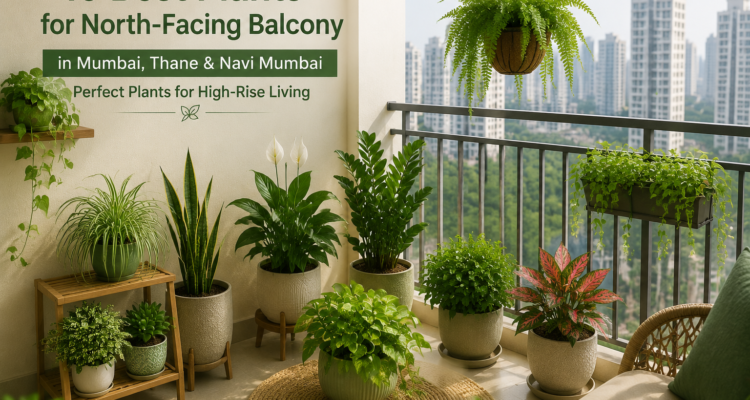
The good news: you don’t need harsh afternoon sun to grow a thriving balcony garden. You just need the right plants for north facing balcony spaces, and a little know-how on how to care for them in Mumbai’s humid, high-rise conditions. This guide covers exactly that — 10 low-light plants that will actually survive (and thrive) on your north facing balcony, where to buy them in and around Mumbai, and the care tricks that make the difference.
If your flat in a Mumbai, Thane or Navi Mumbai high-rise has a north facing balcony, you already know the struggle. You want a green, Instagram-worthy balcony garden, but every plant you bring home from the nursery starts stretching, yellowing, or just sulking within a month. The problem isn’t your green thumb — it’s the direction your balcony faces.
Why North Facing Balconies Are Tricky For Gardeners
Before we get to the plant list, it helps to understand exactly what you’re up against. A north facing balcony in the Northern Hemisphere (which includes all of India) receives little to no direct sunlight through the day — you mostly get soft, indirect light, and even that gets blocked further if you live on a lower floor of a high-rise with neighbouring towers casting shadows.
Here are the specific problems gardeners in Mumbai, Thane and Navi Mumbai high-rises run into on north facing balconies:
- Insufficient direct sunlight: Most flowering and fruiting plants need at least 4-6 hours of direct sun. A north facing balcony rarely gets this, so sun-loving plants like roses, hibiscus, tomatoes or chillies grow weak, spindly and rarely flower well.
- Leggy, stretched growth: Plants that don’t get enough light stretch toward whatever light source is available, resulting in thin, weak stems and sparse foliage instead of a bushy, healthy look.
- Slower growth and smaller leaves: Low light means less photosynthesis, so growth is naturally slower — this is normal for shade-tolerant plants, but frustrating if you’ve picked the wrong ones.
- Overwatering and root rot: This is the big one in Mumbai’s humidity. Because low-light plants use less water, and Mumbai’s air is already humid for most of the year, soil stays wet for longer. Gardeners who water on a fixed schedule (instead of checking the soil) often end up with fungal and root rot issues.
- Fungus and mould on leaves and soil: The combination of low airflow (common on narrow high-rise balconies), high humidity, and shade creates perfect conditions for fungal growth. We’ve covered this in detail in our post on fungus and root rot treatment for Mumbai’s humid climate — worth bookmarking if you’re gardening on a shaded balcony.
- Poor air circulation: Tall neighbouring buildings that block sunlight often block wind too, which compounds the humidity and fungus problem.
- Monsoon waterlogging: A shaded balcony that already struggles with drainage becomes worse in the monsoon. If your balcony floods or stays damp for days, read our guide on stopping waterlogging in your Mumbai terrace or balcony garden.
The fix isn’t fighting the direction of your balcony — it’s choosing plants that are naturally built to handle low, indirect light. Here are our top 10.
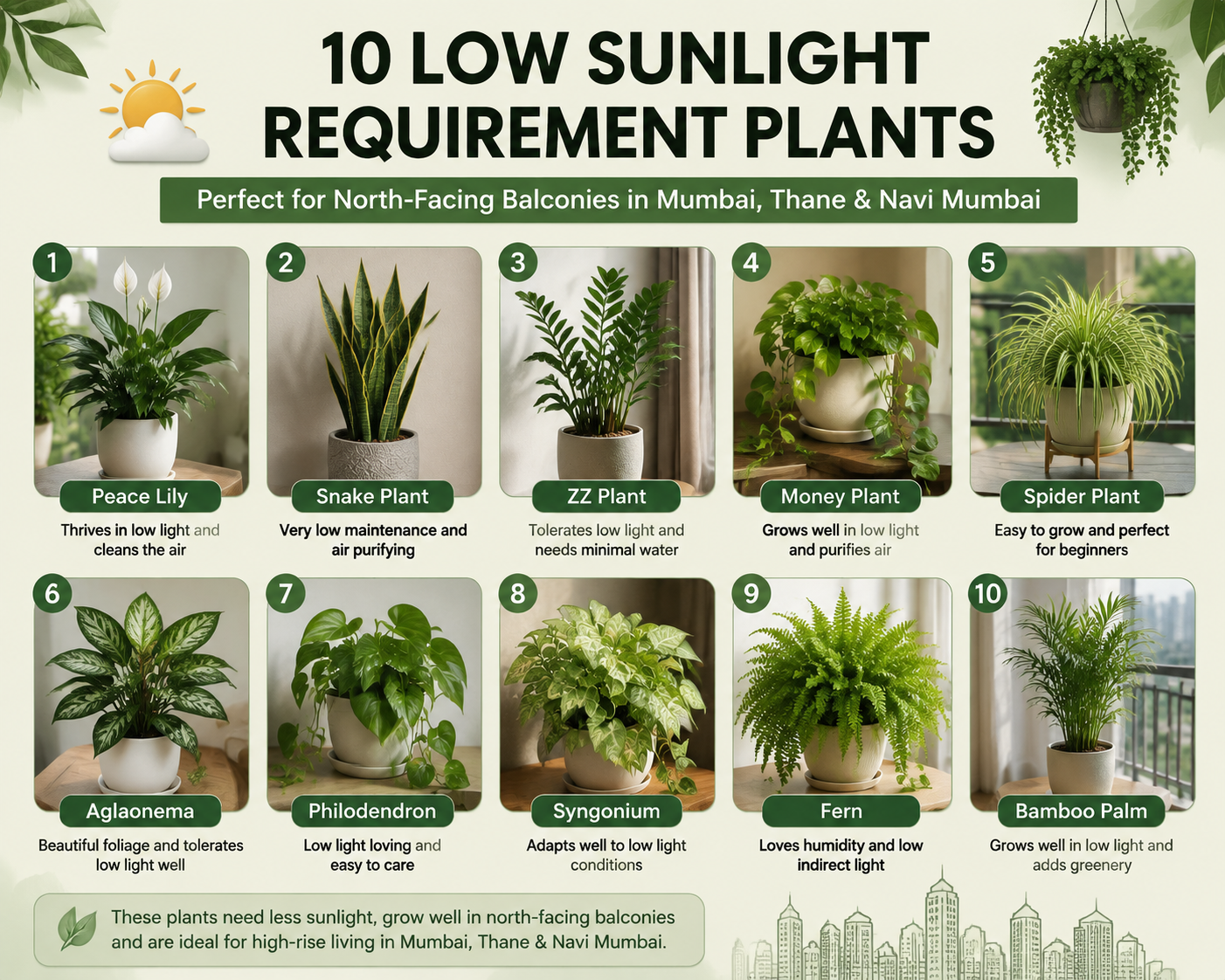
10 Best Low-Light Plants For North Facing Balconies
1. Money Plant (Pothos / Epipremnum aureum)
The most forgiving plant on this list, and a Mumbai balcony classic. Money plant tolerates low light beautifully and grows just as well in a pot of soil as it does in a bottle of water. It’s also considered auspicious as per Vastu — we’ve written more about placement in our guide to Vastu plants for the home with direction and pot guidance.
Care tip: Let the top inch of soil dry before watering again, and wipe the leaves monthly to keep them dust-free and photosynthesising efficiently.
2. Peace Lily (Spathiphyllum)
Peace lily is one of the few low-light plants that actually flowers well in shade, producing elegant white blooms. It also tells you when it’s thirsty — the leaves droop dramatically and bounce back within hours of watering.
Care tip: Keep soil consistently moist but never soggy, and mist the leaves in Mumbai’s drier winter months (December-February) when humidity dips.
3. ZZ Plant (Zamioculcas zamiifolia)
If you’ve killed every plant you’ve owned, start here. The ZZ plant stores water in its rhizomes and can handle weeks of neglect and near-total shade without complaint. It’s practically indestructible on a north facing balcony.
Care tip: Water only once the soil is completely dry — overwatering is the only real way to kill this plant, and it directly causes the root rot issues common in Mumbai’s humidity.
4. Snake Plant (Sansevieria / Dracaena trifasciata)
Snake plant is famous for tolerating low light, irregular watering, and general neglect while still looking architecturally striking. It’s also one of the best air-purifying plants for a balcony that doubles as a reading corner.
Care tip: Use a well-draining cactus/succulent mix rather than regular garden soil, since this plant is far more likely to suffer from wet feet than from lack of light.
5. Spider Plant (Chlorophytum comosum)
Spider plant is fast-growing even in indirect light, and produces baby “pups” on long runners that you can propagate into new pots — great if you want to fill up a balcony without repeatedly buying new plants.
Care tip: Brown leaf tips usually mean tap water minerals rather than light problems — switch to filtered or rain water occasionally if you notice this.
6. Philodendron (Heartleaf Philodendron)
A trailing, heart-leafed vine that looks lush cascading off a railing planter or hanging basket — ideal for narrow north facing balconies where floor space is limited.
Care tip: Train the vines along a trellis or let them trail for a fuller look; pinch growing tips occasionally to encourage bushier growth instead of long bare stems.
7. Syngonium (Arrowhead Plant)
Closely related to philodendron, syngonium has arrow-shaped leaves in green, pink or variegated patterns and handles low light without losing its colour intensity as dramatically as some variegated plants do.
Care tip: Rotate the pot every couple of weeks so growth doesn’t lean permanently toward whatever weak light source it’s chasing.
8. Chinese Evergreen (Aglaonema)
One of the most shade-tolerant flowering-foliage plants available, Aglaonema comes in patterned varieties (silver, pink, red) that add colour to a balcony without needing bright light to look vibrant.
Care tip: Keep it away from cold drafts and AC vents — it prefers Mumbai’s warm, humid air over anything too cool or dry.
9. Boston Fern (Nephrolepis exaltata)
Ferns love humidity, which makes Mumbai’s climate genuinely an advantage rather than a challenge, and they thrive in the indirect, dappled light typical of a north facing balcony.
Care tip: Never let the soil dry out completely — ferns are the one plant on this list that wants consistently moist (not soggy) soil at all times.
10. Calathea (Prayer Plant)
Calathea’s dramatically patterned leaves fold up at night like praying hands, and it genuinely prefers low, indirect light — direct sun actually scorches and fades its leaf patterns.
Care tip: Water with room-temperature, filtered water if possible, since calathea is sensitive to the chlorine and fluoride in regular tap water.
How To Source These Plants: Offline And Online
Buying Offline In Mumbai, Thane And Navi Mumbai
Local nurseries are still the best place to physically inspect a plant’s health, root condition and pest-free status before buying. We’ve put together a detailed guide covering the best plant markets and nurseries near you in Mumbai, including well-known spots for low-light and indoor foliage plants. When buying offline, look for firm leaves, no yellowing at the base, and check the underside of leaves for pests before you pay.
Buying Online
If you’d rather have plants delivered straight to your high-rise doorstep, you can browse our own curated collection of indoor plants and outdoor plants on the Farmer In Mumbai shop, or explore the full gardening products store for pots, fertilisers and soil mixes to go with your new plants. Most of the plants on this list are also widely available on general online nurseries and marketplaces — just make sure the seller ships appropriately for Mumbai’s humidity (breathable packaging, moist but not soaked root balls).
Tips And Tricks For Caring For Low-Light Balcony Plants In Mumbai
- Water by touch, not by schedule. Stick a finger an inch into the soil before watering — low-light plants use water far more slowly than sun-loving ones, and Mumbai’s humidity keeps soil moist longer than you’d expect.
- Use the right soil mix. Low-light plants are more vulnerable to root rot, so drainage matters even more than usual. Our plant-by-plant soil mix guide for Mumbai breaks down the right mix for each plant type.
- Wipe the leaves regularly. Dust blocks what little light your plant is already getting. A damp cloth once every couple of weeks noticeably improves growth on shaded balconies.
- Avoid monsoon mistakes. Overwatering during Mumbai’s already-humid monsoon is the single biggest cause of plant loss on shaded balconies — see our list of monsoon gardening mistakes to avoid.
- Fertilise lightly and less often. Low-light plants grow slower, so they need roughly half the fertiliser dose (and half the frequency) of sun-loving plants — over-fertilising a shade plant just burns the roots without speeding up growth.
- Improve airflow where you can. If your balcony is enclosed or narrow, a small oscillating fan on low speed for a few hours a day reduces fungal issues significantly without disturbing the plants.
- Rotate pots every 1-2 weeks. Even indirect light has a direction. Rotating prevents one-sided, leggy growth and keeps the plant’s shape even.
- Check your society’s rules before installing railing planters or trellises. If you’re setting up hanging baskets or railing-mounted pots, it’s worth a quick read of our post on balcony garden rules and regulations in Mumbai housing societies so you don’t run into issues with your RWA later.
- Watch for pests hiding in shade. Low light, high humidity balconies can attract mealybugs and fungus gnats. Keep a mild neem oil spray handy and check the underside of leaves weekly — browse our pest and insect control range if an infestation gets ahead of you.
Final Thoughts
A north facing balcony in a Mumbai, Thane or Navi Mumbai high-rise isn’t a dead end for gardening — it’s just a different set of rules. Skip the sun-hungry flowering plants and lean into money plant, peace lily, ZZ plant, snake plant, spider plant, philodendron, syngonium, Chinese evergreen, Boston fern and calathea, and you’ll have a genuinely lush, low-maintenance green corner that suits exactly the light you’ve got.
If you’d rather skip the trial and error altogether, get in touch with our team — at Farmer In Mumbai, our philosophy is simple: Making Every Home A Garden, whatever direction your balcony faces.

Akhilesh Maurya
Administrator at Farmer In Mumbai
- 15 Best Microgreens To Grow At Home In Your Balcony : A DIY guide
- How to Start an Areca Leaf Plate Making Business in India (2026 Guide)
- 12 Indoor Vastu Plants for Home in Mumbai With Direction And Pot Guide
- 10 Private Terrace Garden Ideas For Mumbai, Navi Mumbai And Thane Residents With Rules And Regulations
- How to Make Self Watering Pots at Home : 3 Easy DIY Methods
- How To Use Cocopeat For Plants : A Complete DIY Guide
- Balcony Garden Rules And Regulations In Mumbai Housing Societies
- Compost Bin For Kitchen Waste And Garden : A DIY Guide to Make, Buy and Use It
- Laid Off or Burned Out? 6 Small Garden Business Ideas You Can Start For Under ₹15,000
- Get Pesticide Free Vegetables Near Me in Mumbai: How to Verify Before You Buy
- 7 DIY Methods To Get Rid Of Mealybugs On Plants Naturally
- Best Soil Mix for Indoor Plants in Mumbai: A Plant-by-Plant Guide